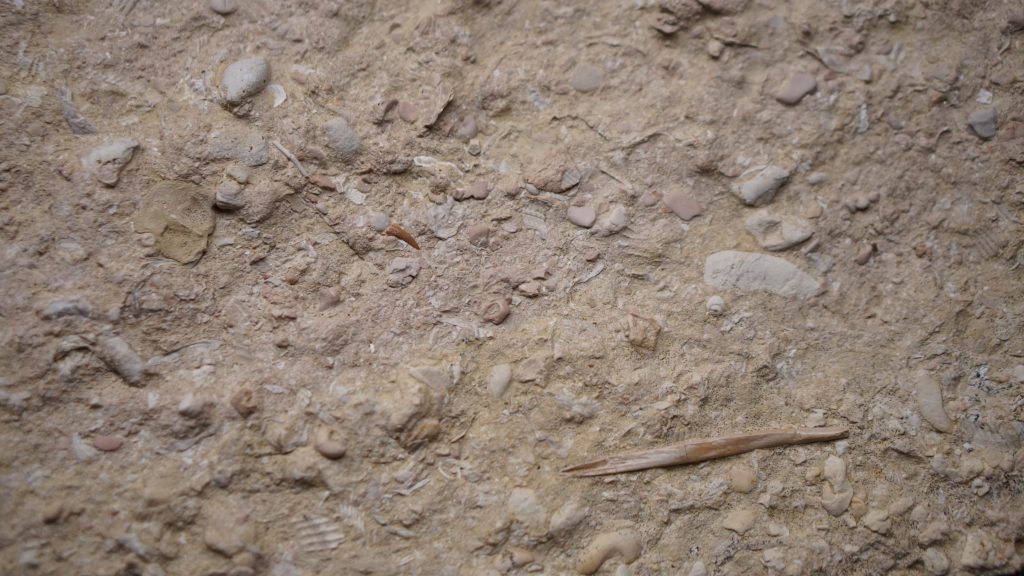

Eosauropterygia indet.
Dating uncertain – Upper Röt or Lower Muschelkalk (Anisian)
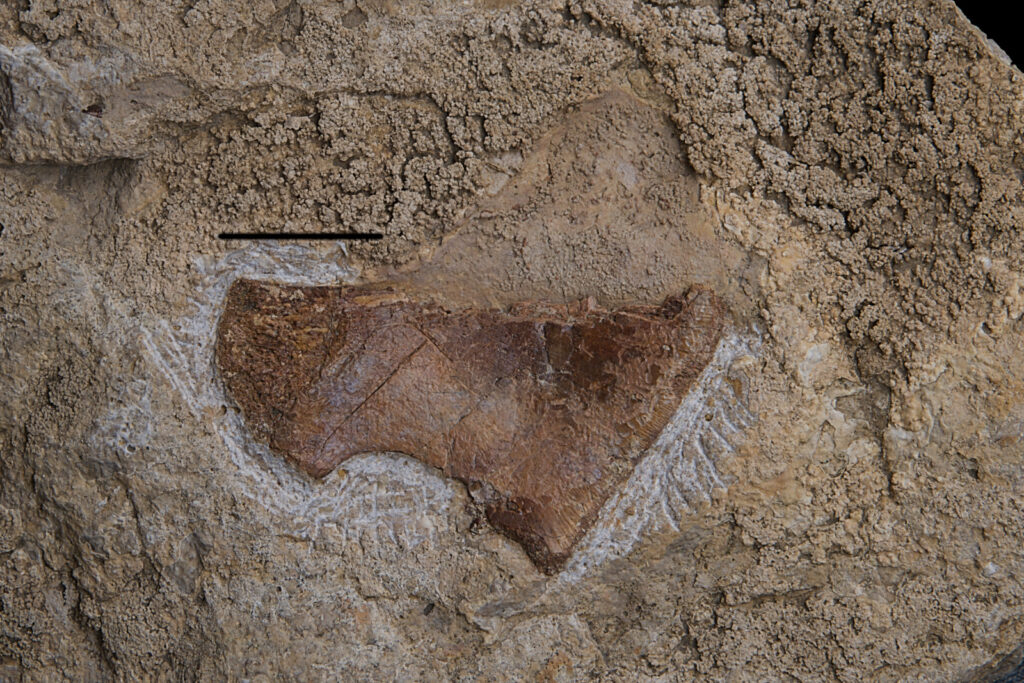
The presented specimen is an ischium of an unidentified Eosauropterygia. The ischium is a bone that forms part of the pelvic girdle.
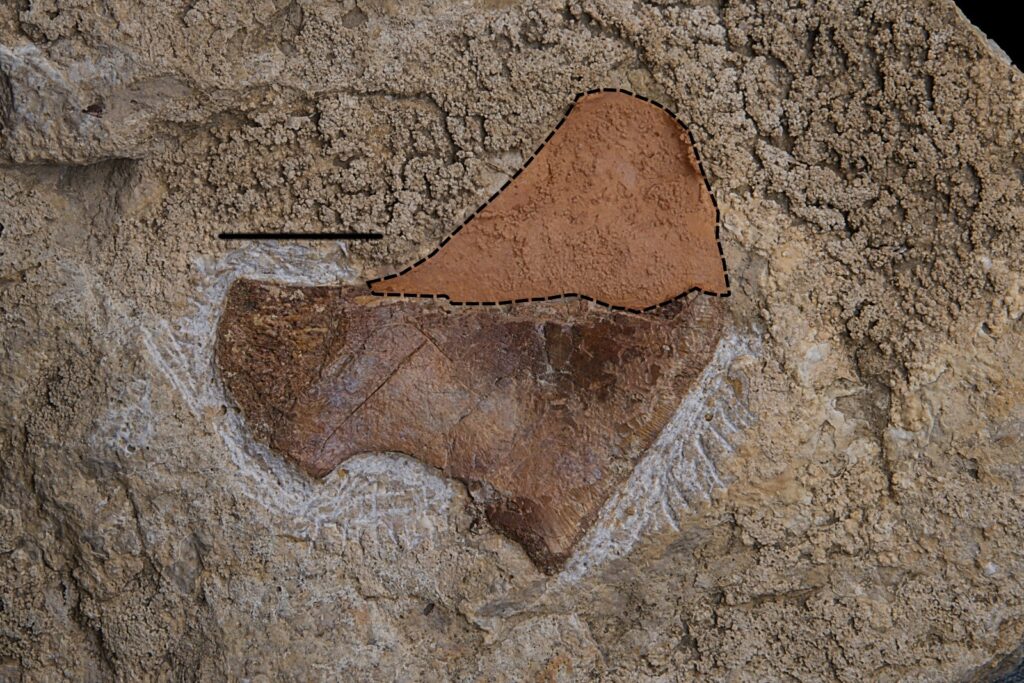
The specimen is damaged by erosion – the surface of the ischium’s head is severely worn, as is the surface of the distal part, losing its original texture. Additionally, about half of the distal fan is missing. Length of the spcimen is about 60 mm, width of the fan 65 mm.
The second photo shows a reconstruction based on a preserved negative of the missing part.
The specimen’s features are not consistent with placodonts – in this case, the head would be significantly shorter, and the bone itself would be more asymmetrical and robust. It is also inconsistent with other, more specialized and terrestrial reptiles.
The strongly fan-shaped shape with a distinct, long head and a rather symmetrical distal fan strongly suggests that the bone belonged to a representative of Eosauropterygia, a rather large individual.
On the other hand, one can see a certain asymmetry of the fan, which I did not observe in the photos in the literature, but I am not able to suggest a more precise identification, especially since the specimen is rather poorly preserved.
Reference:
- Williston, S. W. (1925). The Osteology of the Reptiles. Cambridge: Harvard University Press.
- Diedrich, C. G. (2013). Marine Triassic reptile biodiversity and change in the Bad Sulza Formation (Illyrian, Middle Triassic) of Central Germany and a contribution to the evolution of Nothosaurus in the Germanic Basin. New Mexico Museum of Natural History and Science Bulletin, 61, 147-157.
Leave a Reply