
Placodus sp. Saurosphargis sp.
Middle Triassic, Lower Muschelkalk, Gogolin Beds (Anisian)
Upper Silesia, Poland
The specimen is a large, but unfortunately incomplete, vertebra of a Middle Triassic marine reptile. The morphology of the vertebra is consistent with dorsal vertebrae of Placodus sp. Saurosphargis sp. reported in the literature.
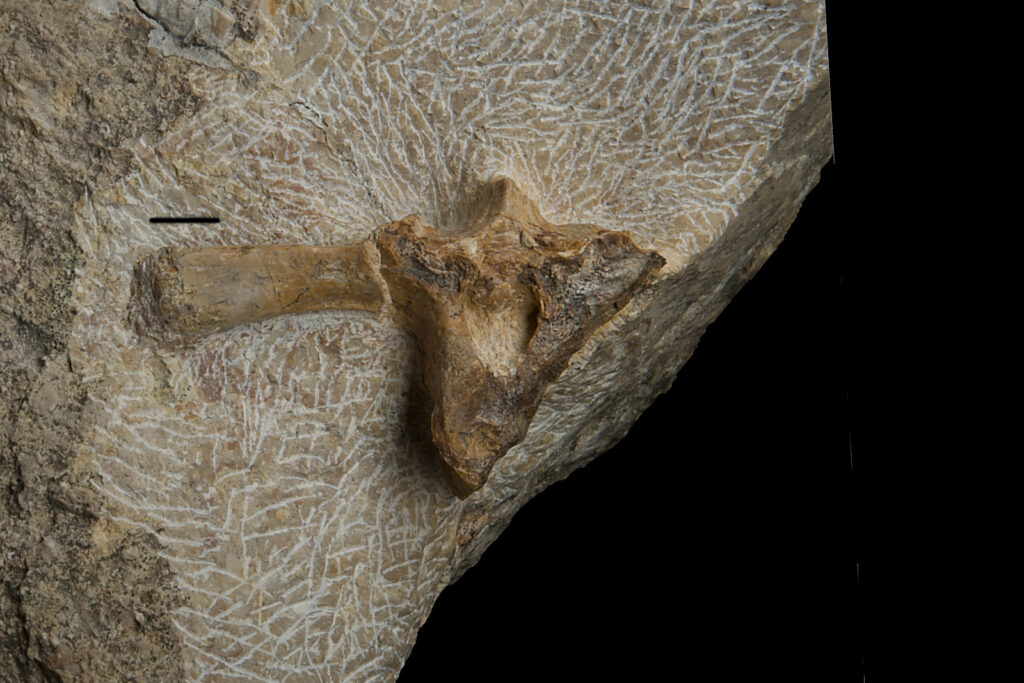
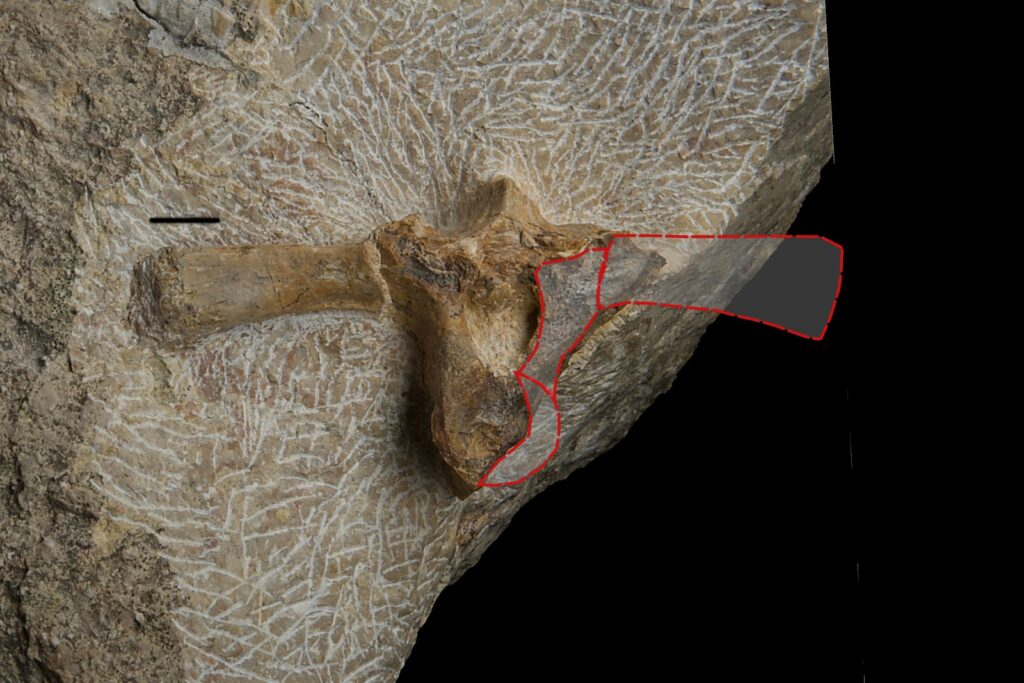
The significantly eroded specimen rests flat on the matrix, showing the anterior side of the vertebra. The right transverse process, most of the neural arch, and slightly more than half the diameter of the centrum are preserved. The prezygapophysis and neural spine are absent, with only the base of the spine visible. The postzygapophyses have been prepared out and are visible in dorsal view.
The width of the preserved portion is ~64 mm and the height is ~37 mm. The length of the preserved transverse process is ~22 mm. The length of the centrum (measured in lateral cross-section) is ~19 mm.
The transverse process is preserved in its position but broken off from the rest of the neural arch. A distinct crack is visible. The short neural spine was not eroded contemporaneously—the preserved part was prepared out from the matrix as it is. Both of these features suggest significant mechanical damage before fossilization was completed.
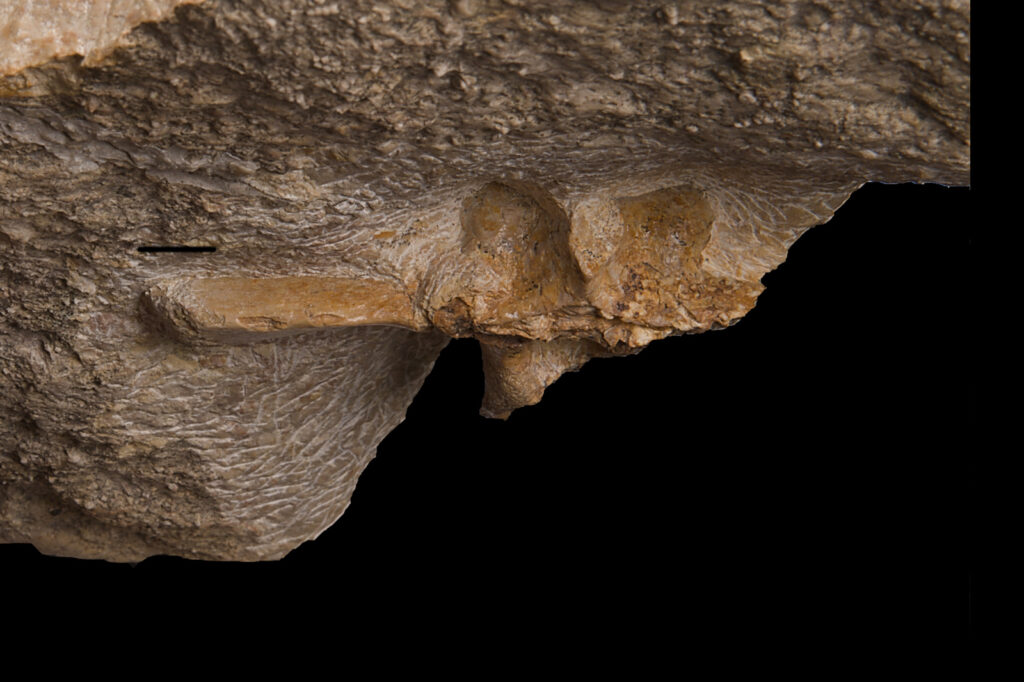
The partially preserved vertebral centrum displays profound amphicoelicity. There are no visible processes or scars left by them on the lateral surface. In cross-section the centrum is quite strongly constricted.
The neural canal is of considerable size, oval or heart-shaped, tapering towards the centrum, although it is not strongly elongated dorso-ventrally, rather moderately.
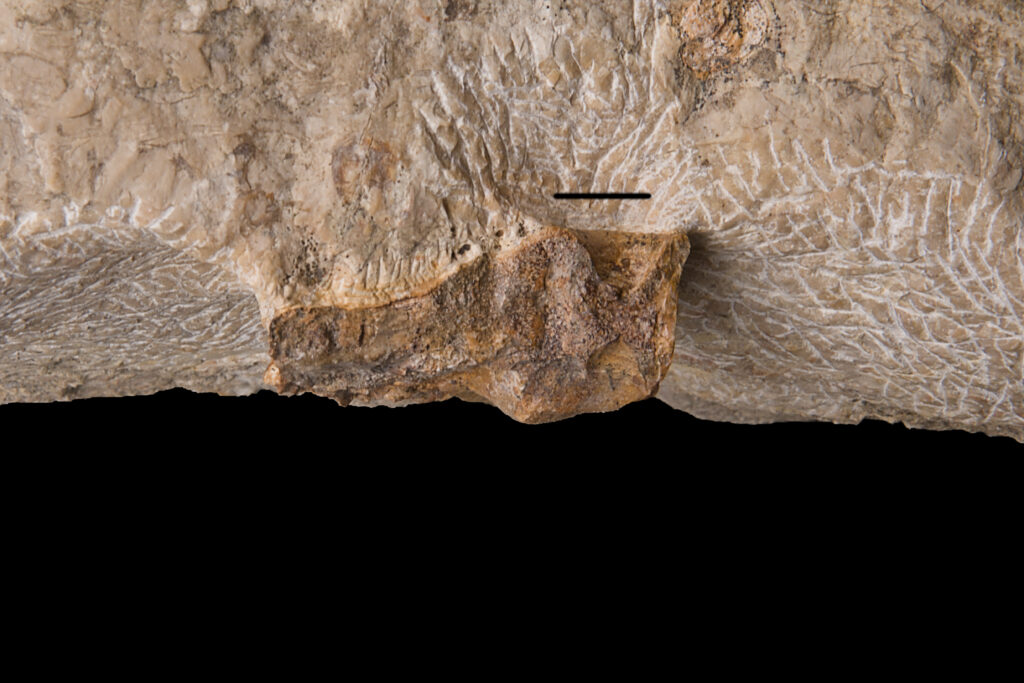
A schematic reconstruction of the entire vertebra is visible in photo 4, where the missing elements have been schematically added: the left transverse process, the left part of the neural arch (partially preserved), and the missing part of the centrum. I have not attempted to reconstruct the neural spine, but according to the literature, it was likely quite long and massive. The probable estimated dimensions of the complete vertebra are: width ~80-85 mm, centrum diameter ~27 mm.
Several basic morphological features—the significantly long transverse processes, the diameter of the neural canal, the deep amphicoelicity of the vertebral articular surfaces, and the overall massiveness of the vertebra—virtually rule out Eosauropterygia. On the other hand, these features are consistent with the general morphological characteristics of large placodonts. Therefore, it seems reasonable to assign the specimen to Placodus sp. Therefore, it is understandable that the specimen was originally designated as Placodus sp.
However, it appears that typical Placodus sp. vertebrae are taller and their neural canals are significantly more elongated (more elliptical than oval, as in this case). (Rieppel 1995, Diedrich 2013) Similarly, the neural spine is usually significantly elongated, which in turn results in its rather wide base. In the case of 41/LMK, the preserved base (or even the complete neural spine) is not as massive as in specimens of Placodus sp. in the literature and supports Saurosphargis interpretation. The relatively short neural spine of S. is beacuse of its flattened body profile covered with osteoderms (some of which were attached to the top of the neural spines – not preserved).
Based on the above set of differences, a comparison with other S. specimens and suggestions from professional paleontologists, the specimen appears more consistent with the dorsal vertebrae of Saurosphargis sp. (Li et al. 2011). Saurosphargis sp. is well-known from the Lower Muschelkalk of Upper Silesia, so this interpretation is additionally supported.
The taxonomic position of Saurosphargidae is still a matter of debate. Recent phylogenetic analyses (Wolniewicz et al., 2023) associated with the discovery of Prosaurosphargis yingzishanensis place Saurosphargidae within Sauropterygia. However, the resaarch history of this clade is complex and full of twists, and further updates are expected.
References:
- Rieppel, O. (1995). The Genus Placodus: Systematics, Morphology, Paleobiogeography, and Paleobiology. Fieldiana: Geology, New Series, No. 31: 1–44.
- Li, C., Rieppel, O., Wu, X. C., Zhao, L. J., & Wang, L. T. (2011). A new Triassic marine reptile from southwestern China. Journal of Vertebrate Paleontology, 31(2), 303–312. https://doi.org/10.1080/02724634.2011.550368
- Wolniewicz, A. S., Shen, Y., Li, Q., Sun, Y., Qiao, Y., Chen, Y., Hu, Y.-W., & Liu, J. (2023). An armoured marine reptile from the Early Triassic of South China and its phylogenetic and evolutionary implications. eLife, 12, e83163. https://doi.org/10.7554/eLife.83163
Leave a Reply