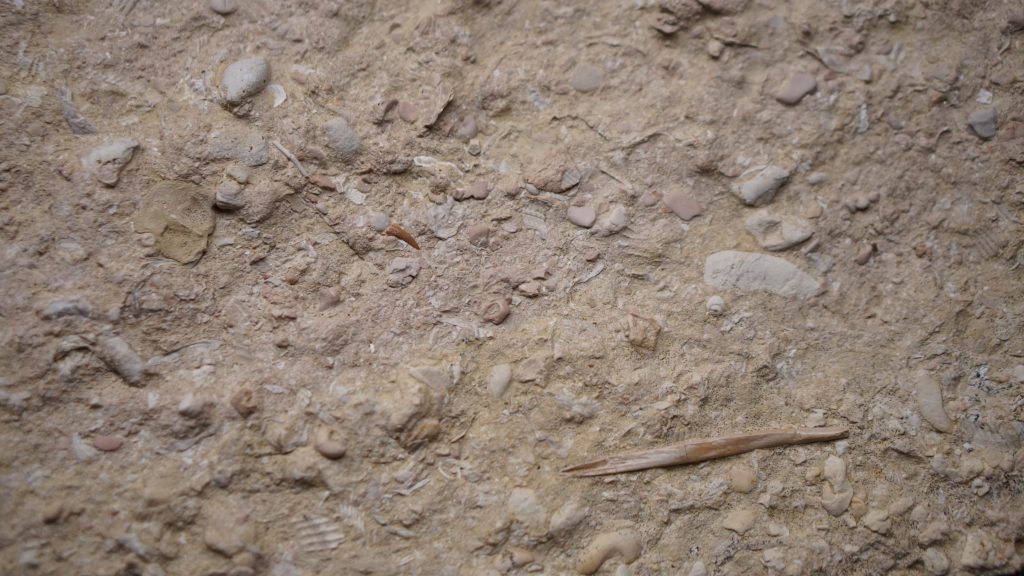

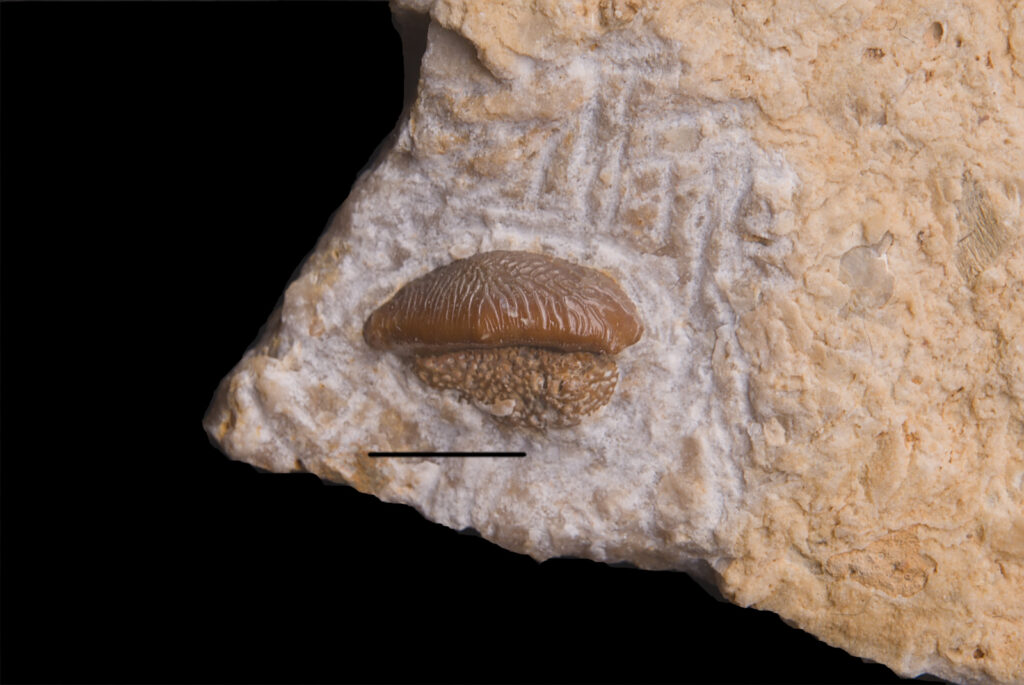
| Acrodus cf. lateralis |
| tooth |
| Upper Muschelkalk (Middle Triassic, Ladinian) |
| Upper Silesia, Poland |
Description
A specimen of a shark tooth from the genus Acrodus, identified as Acrodus cf. lateralis from the Upper Muschelkalk (Middle Triassic, Ladinian) deposits in Upper Silesia. Relatively unusually, the tooth has a preserved root.
The tooth crown is approximately 9 mm long and 3 mm high. The well-preserved root measures 8 mm by 4 mm. The tooth crown is characterized by ornamentation consistent with the genus Acrodus, with the ridges converging towards the tooth tip, similar to to that of A. lateralis.
The vast majority of hybodontiform teeth in the collection are preserved without roots. 11/UMK is an exception.
According to Böttcher (2024), hybodontids experienced root resorption when a tooth was replaced, which is why the vast majority of specimens found are rootless. If this interpretation is correct, the preserved root may be consistent with the tooth having been shed after the animal’s death.
References
- Böttcher, R. (2024). Root resorption during tooth replacement in sharks – a unique character of the Hybodontiformes (Chondrichthyes, Elasmobranchii). Palaeodiversity, 17(1), 121–194. https://doi.org/10.18476/pale.v17.a6
- Böttcher, R. (2015). BÖTTCHER, R. (2015): 8. Fische des Lettenkeupers. – In: HAGDORN, H., SCHOCH, R. & SCHWEIGERT, G. (eds.): Der Lettenkeuper – Ein Fenster in die Zeit vor den Dinosauriern. – Palaeodiversity, Sonderband: 141–202. Palaeodiversity, Sonderband, 141–202.
Leave a Reply